
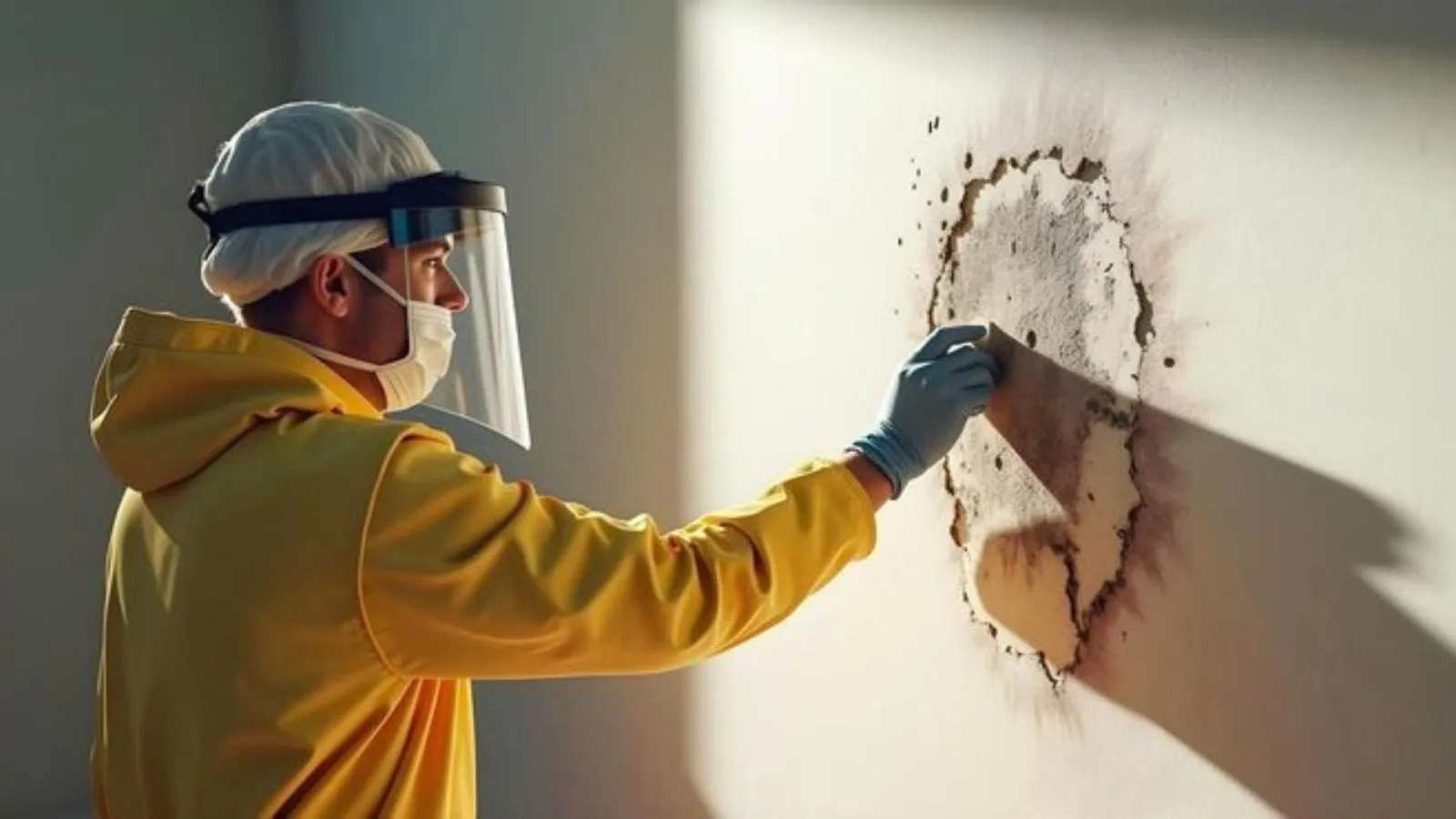
The cleaning aisle offers many mold products, and they are fine for the right job. The question is whether your job is the right one. This guide compares household cleaning with professional remediation without recommending any particular product.
Neither approach works unless the moisture is fixed.
What store-bought cleaners can do
Household cleaners can remove surface mold from hard, non-porous materials such as tile, glass and sealed fixtures. Used with gloves, ventilation and a cloth, they work for small, contained spots. Follow the label and never combine products.
They do not fix the cause, and they do not reach mold growing inside drywall, carpet or insulation.
What remediation adds
Professional remediation adds containment, so spores do not travel, along with removal of porous materials, air filtration, cleaning of surfaces and drying. It also starts by finding the moisture source, which a cleaner cannot do.
| Factor | Household cleaner | Remediation |
|---|---|---|
| Best for | Small spots on hard surfaces | Larger areas, porous materials |
| Finds moisture source | No | Yes |
| Containment | No | Yes |
| Removes damaged drywall | No | Yes |
| Cost | Low upfront | Depends on scope |
| Risk of regrowth | Higher if source remains | Lower when dried |
How to decide
Ask three questions. Is the area larger than a few square feet? Is the material porous? Do you know where the moisture came from? If any answer worries you, get an assessment before buying products.
A good assessment explains what is wrong, what will be done and what it will cost before work starts.
Reading the label and the claims
Labels list what a product is meant to do, where it can be used and what safety steps to follow. Many are designed for surface cleaning and say nothing about killing mold inside materials. Read for the surfaces named, the dwell time and the ventilation instructions.
Do not combine two products. Bleach and ammonia-based cleaners, for example, can produce dangerous fumes.
Total cost thinking
A cleaner costs little, but a repeated cleaning cycle adds up if the cause is not fixed. A professional job costs more upfront and addresses the source, containment and drying together. Which one costs less over time depends on whether the mold returns.
Ask for a written scope before deciding, and compare it with what you have already spent.
Health and safety notes before you start
Mold can irritate the eyes, nose and throat, and some people react more strongly than others. Anyone with asthma, allergies or a weakened immune system should leave cleaning to someone else. Never mix bleach with ammonia or acids, and never use two cleaners in the same bucket.
Use a respirator, not a paper dust mask, and ventilate the room outward.
What a remediation visit looks like
A remediation visit begins with a walk through and moisture readings, then a written scope. Work areas are sealed with plastic, and air filtration runs while materials are removed. Surfaces are cleaned and the space is dried before anyone talks about rebuilding.
You should receive photos of the work and a clear description of what was removed and why.
When a cleaner is the wrong first move
If the stain keeps returning, if the smell is stronger than the visible mold or if the wall is soft, a cleaner is not the first move. The right first move is to find where the moisture is coming from. Cleaning first can hide the evidence you need to find the cause.
Take photos before you clean, and note any area that feels cool or damp.
Questions to ask before choosing remediation
Ask how the company will find the moisture source, how the work area will be contained, what will be removed and how it will be disposed of. Ask whether drying readings are included and what happens if growth is found behind a wall later.
Ask for a written scope so you can compare it with any other quote.
A fair way to compare the two options
Price the cleaner and your time. Then ask a professional what the full scope would involve and what it would cost. If the gap is small and the area is large, remediation often makes more sense. If the area is tiny and the cause is clear, a careful cleaning may be enough.
Either way, fix the moisture. Without that step, neither choice lasts.
Standards and Sources Behind This Page
The ANSI/IICRC S520 standard for professional mold remediation and the EPA guide A Brief Guide to Mold, Moisture, and Your Home are the references behind this comparison. EPA advises that moisture control is the key and that small patches may be handled by the homeowner.
What this looks like in Stoughton
Stoughton homeowners call about mold after leaks under sinks, around bathrooms and near basement stairs. Massachusetts has no state mold remediation license, so the quality of the contractor depends on references and a written scope. Home improvement work on owner-occupied homes requires a registered contractor under state rules.
To see how professional work compares, read mold remediation and crawl space water damage for hidden moisture. We serve Holbrook and Avon as well.
Common questions
Not reliably. Drywall is porous, so surface cleaning leaves growth inside.
On a hard, non-porous surface, yes, with gloves and ventilation. Fix the moisture too.
When the area is large, the material is porous or the cause is unclear.
Ask for references, a written scope, how moisture will be fixed and for their Massachusetts home improvement registration where required.
They may help on small hard-surface spots, but they do not address porous materials or the moisture source.